




How customer decisioning is redefining modern marketing by enabling real-time, AI-led growth and intelligent experiences.
In today’s marketing landscape, Customer Decisioning is quickly emerging as one of the most critical and topical subjects. As brands race to deliver personalised, real-time experiences, the real differentiator is not just data collection or channel activation – it’s the intelligence layer in between. Welcome to ‘CustomerDecisioning.’
The rise of AI-driven decisioning is accelerating this shift
Product companies are doubling down on investment in adaptive models, reinforcement learning, and real-time optimisation. Yet for many brands, Customer Decisioning remains an under-realised capability, often overshadowed by channels, data, or content.
It is the critical capability that translates data into context-aware actions, ensuring the right message, offer, or experience is delivered at the right moment. Without a strong decisioning foundation, brands risk continuing to operate in silos, relying on human guesswork, and falling short of customer expectations in an AI-driven world.
Pawan Verma Head of MarTech Bupa Australia and myself, recently unpacked this as part of the closing keynote at The Martech Retreat 2025 in the beautiful Mornington Peninsula, Melbourne organised by MadTech Collective by Ashton Media. We discussed why decisioning matters now more than ever, how leading organisations are approaching it, and what practical steps marketers can take to put Customer Decisioning at the core of their transformation journey.
If you believe decisioning is simply about thinking, think again!
Decisioning is not about thought; it is the process of executing a decision. In reality, decisioning acts as the nervous system of an organisation—pervasive, connecting people, rules, data, and processes. It senses, routes, and responds to interactions and reactions.
Too often, organisations approach decisioning backwards starting with data, models, or tools. In truth, decisioning should begin with a piece of paper. The clarity of intent must come first. If you can map how you want decisions to happen—who decides, on what basis, under what constraints—then everything else, from data pipelines to machine learning, will fall neatly into place.
If you can get it right on Paper, everything else will fall into place.
The Golden Age of Marketing Technology
We are now in the golden age of marketing technology, a time not of scarcity, but of abundance. Data, technology, channels, and AI are now plentiful, accessible, and scalable. Yet paradoxically, this abundance has created confusion, fragmentation, and fatigue.
Let’s explore the four pillars shaping the marketing frontier.
1. Data: From Collection to Comprehension
The volume and variety of data have grown exponentially—from 2 zettabytes in 2010 to 180 zettabytes in 2025. Data now comes in many formats: structured, unstructured, first-party, second-party, third-party, behavioural, transactional, contextual, batch, streaming, and more.
The challenge has shifted from collection to comprehension. We have more dashboards, but fewer insights. More metrics, but less meaning.
True decisioning requires more than big data; it demands smart interpretation—the ability to connect what the data says to what the business should do.
2. AI: From Automation to Intelligence
AI has become the new operating system of marketing. But we must evolve beyond Generative AI prompts to predictive, adaptive, and contextual AI—systems that don’t just assist but decide.
Modern marketing AI now arbitrates in real time—determining who, what, when, and why—not just which segment or next-best offer. Solutions like Pegasystems Adaptive Models, Google Vertex AI, and Databricks Mosaic exemplify this shift: AI that senses, learns, and adjusts based on outcomes.
This is the rise of cognitive decisioning—AI as a co-pilot that interprets, optimises, and improves continuously.
3. Technology: From Stacks to Ecosystems
The MarTech landscape has exploded, with over 15,000 platforms in 2025 compared to just 150 in 2011. The trend is shifting from best-of-breed chaos to composable ecosystems, where data, decisioning, and delivery layers interoperate seamlessly.
Modern architectures now blend:
- Data platforms (Databricks,Snowflake )
- Decisioning engines (Pegasystems,Adobe Journey AI,Salesforce Einstein)
- Engagement tools (Braze, Iterable,Bloomreach ,Salesforce Marketing Cloud)
- Privacy and consent frameworks (CMPs and compliance layers)
This interoperability enables marketing that is real-time, rule-driven, and responsible.
4. Channels: From Media to Moments
Marketing no longer happens in “channels. “It happens in moments—each shaped by context, emotion, and immediacy. A channel is a medium for interaction, not the interaction itself. A touch point is a specific moment where a need is addressed.
Marketing has evolved beyond traditional channels to contextual engagement. Customers interact through 15+ touchpoints—web, app, email, push, retail, social, and voice assistants.
They expect continuity: 71% expect personalised interactions, and 76% are frustrated when this does not happen (McKinsey, 2023). The proliferation of APIs, event buses, and channel connectors have made omnichannel engagement technically possible. But the shift from media management to moment orchestration requires one missing piece: decisioning.
The unit of marketing has shifted from “campaigns” to “moments”.
The Paradox of Plenty
We are working harder, spinning faster yet moving backwards. Despite this abundance of data, technology, channels, and AI, marketing effectiveness has not improved.
Research shows:
- MIT: 95% of enterprise GenAI pilots fail to deliver measurable business impact or ROI.
- HBR: Despite 25% of marketing budgets spent on MarTech, 49% of marketers report results do not meet expectations, and 44% of purchased MarTech tools go unused.
- Supermetrics: Marketers handle 230% more data than in 2020, but 56% lack time to analyse it.
- Shopify: While 92% of brands claim to offer personalisation, only 19% of US consumers rate these experiences as “good”—and 0% as “excellent”.
- McKinsey: Not a single Fortune 500 marketing leader could clearly explain how their MarTech investments led to measurable ROI.
Marketing has become more complex, not smarter. We are busy, but not better. We have become technologists of tools, not architects of decisions.
The Decisioning Crisis
The C-suite is at a crossroads, questioning whether variety is causing confusion, whether there is too much data and technology, and where to start: the right tools, platforms, teams, and partners.
The problem is not data, technology, or channels—it is our ability to decide. We face a decisioning problem: Who to engage, what to offer, when to act, and how to deliver consistency across touchpoints and delivering a seamless, connected, and continuous experience.
We face not an information crisis, but a decisioning crisis.
Bridging the Connection Gap: The Need for Decisioning
Marketing has always been about connections—meeting human needs at moments that matter, but
- Every interaction generates data
- Every channel fragment attention
- Every new data source multiply complexity
What this does, it creates a connection gap. Decisioning is what closes this gap. It is the connective tissue between data, insight, and experience. We’ve matured in data and delivery, but decisioning remains an underdeveloped frontier.
Without it, marketing becomes a collection of tools—fast, noisy, and disjointed.
So, how do we address this? Welcome the Customer Decisioning Blueprint
The Decisioning Iceberg
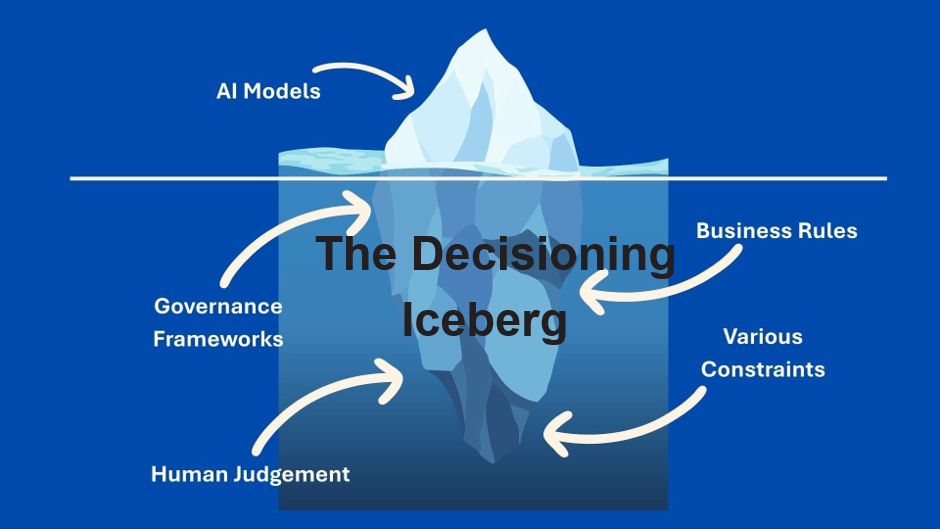
Most organisations see only the visible tip of the iceberg—the AI models, dashboards, and vendor demos. That’s merely 30% of the decisioning landscape.
The invisible 70%—where success actually lies—includes:
- Governance frameworks
- Business rules and constraints
- Bias management
- Performance monitoring
- Human oversight and ethics
Decisioning is not a technology stack. It is an organisational muscle—a blend of architecture, governance, and adaptability.
To guide this evolution, we came up with the development of the Customer Decisioning Blueprint—a practitioner-owned, vendor-agnostic framework that helps organisations design decisioning systems tailored to their DNA.
The T – Shaped Decisioning Blueprint
The T-shaped Customer Decisioning Blueprint illustrates:
- Horizontal capabilities that demand enterprise alignment – Data Foundations, Decisioning Intelligence & Business Context
- Vertical capabilities that demand deep domain skill – Real Time Optimisation, Omni Channel Activation
- A surrounding wrapper of governance and adaptation – Continuous Measurement & Value Realisation
This ensures decisioning systems are scalable, transparent, and human-aligned.
The Future of Marketing: AI Agents and Zero-Touch Execution
Looking ahead, marketing will enter the era of AI agents—autonomous systems that think, act, and converse, while humans provide governance and direction.
We will evolve through three stages:
- Human Initiated – Ideas, context, intent
- AI Structured – Data synthesis and contextual support
- Human Refined – Storytelling, empathy, ethical oversight
Eventually, AI will converse with humans, not just execute commands. It will reason, adapt, and negotiate outcomes in real time, while humans focus on strategy, creativity, and trust.
With this, the future is defined by two converging paradigms:
The next big thing is Autonomous Contextual Marketing enabled by Zero-Touch Execution.
- Autonomous Contextual Marketing marks a shift from rule-based, reactive marketing to proactive, AI-driven orchestration. Algorithms no longer follow instructions—they understand purpose. They decide what matters most, when it matters, for whom.
- Zero-Touch Execution the logical endpoint of automation. Marketing systems that require no manual setup, no routine intervention. They become living ecosystem – self-optimising, responsive, and self-healing.
Together, these define the next evolutionary phase: marketing that thinks, acts, and adapts by itself.
Marketing was once about storytelling. Then it became about data. Now, it must become about decisioning—the art of connecting the two. The future of marketing will not be defined by more tools, but by smarter decisions. We will move from Martech to Mindtech—systems that don’t just automate tasks but elevate intelligence.
As AI agents become our digital colleagues, marketers must evolve into decision architects—designers of intent, ethics, and outcomes. When technology begins to think, humans must lead with purpose. That is how we will build marketing systems that are not just autonomous—but truly intelligent.
Ultimately, Decisioning is not the endgame—it is the enabler of a more intelligent, empathetic, and human future.
For more expert articles and industry updates, follow Martech News

Satya Upadhyaya, Martech Leader
Satya has an extensive and impactful career in marketing data and enablement, He is a seasoned professional with 15 plus years experience whose contributions have significantly advanced organisational capabilities in leveraging technology to foster data-driven strategies, demand generation, and revenue growth holding leadership roles with brands like ANZ Bank, nab, Citibank, HSBC, Bankest, The NRMA, The Star Casino, Tabcorp.
His expertise spans the entire lifecycle of customer experience and digital transformation from leading development and delivery of vision and roadmap, business case validation, simplifying technology adoption through capability assessment and putting in place utilisation goals to operating under risk compliance and control guardrails for design, implementation, execution, and monitoring with continuous improvements across platforms and channels.
As a recognised thought leader, Satya has taken the stage as a keynote speaker and has enriched the marketing community by authoring the MarTech Certificate Course at ADMA
Head of Martech & CRM | Business Architect | Decisioning, Automation & AI | Technology, Data & Marketing Transformation | Omni-Channel 1-1 Personalisation | Keynote Speaker-help CMO/CIO build,enable business capability.