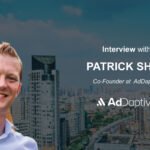




Patrick shares insights on AI, flexible pricing, and execution velocity, revealing how B2B marketers can stay agile and outperform competitors.
Patrick, you’ve played a pivotal role in shaping AdDaptive over the past 15 years. Could you share a bit about your professional background and what inspired you to co-found a company that’s now leading innovation in B2B advertising technology?
My background started in operations, running campaigns and managing technology for a publisher, and that’s where Kevin and I first connected. What we both saw was a major shift on the horizon: data was beginning to transform advertising. We believed there was an opportunity to apply data in smarter ways to deliver stronger marketing outcomes.
When I co-founded AdDaptive, the vision was simple but ambitious; leverage data to improve results across as many types of campaigns as possible. We began by building an audience extension platform for publishers, helping them ingest and activate first-party data. Over time, it became clear that our approach was uniquely well-suited for B2B. That’s when we doubled down on building a platform that combines our proprietary assets with clients’ data to drive measurable, outcome-oriented campaigns. That foundation has carried us forward as the needs of B2B marketers have evolved.
What are the biggest frustrations B2B marketers face with traditional SaaS pricing models, and how is the shift to consumption-based pricing solving them?
The frustrations are twofold: cost and commitment. Traditional SaaS contracts are expensive, rigid, and often require long implementation cycles. Once you’re locked in, switching is difficult and costly. In a market that’s changing rapidly, especially with AI reshaping capabilities year by year, committing to five- or ten-year bets on a single platform feels risky.
Consumption-based pricing addresses that by aligning spend with value. Instead of paying for unused licenses or features, marketers can scale usage up or down based on actual needs. It removes barriers to entry, reduces risk, and gives marketing teams more agility.
How does AdDaptive’s flexible pricing approach empower mid-market brands to compete with enterprise players in terms of targeting and reach?
Flexibility is the great equalizer. Mid-market brands often don’t have the resources or internal infrastructure to manage enterprise-level SaaS contracts. By offering a pricing model that’s campaign-based and commitment-free, we give those brands immediate access to enterprise-grade targeting and reach without the overhead.
And it’s not just the mid-market. We see global enterprises demanding that same flexibility, because even at scale, they don’t want to be constrained by rigid partnerships. The benefit for the mid-market is that they now stand shoulder-to-shoulder with larger competitors in terms of capabilities.
With AI tools now accessible to almost everyone, what separates teams that succeed from those that get stuck in planning or analysis paralysis?
The teams that succeed are the ones that execute. Access to AI is no longer the differentiator it’s how quickly and effectively you put it into practice. Successful teams start small: they build prototypes, test use cases, and generate quick wins. Those wins build expertise and momentum.
The teams that get stuck are the ones trying to overhaul everything at once. AI adoption doesn’t need to be an “all or nothing” initiative. It’s about steady progress and applying the technology in ways that create immediate value.
How is AI reshaping internal team dynamics — from strategy to execution — in B2B media organizations?
AI is increasing leverage for skilled individuals. What used to require a team of ten can now be achieved by two or three high-performing people equipped with the right tools. That shifts the balance of value inside organizations, where independent contributors can now have outsized impact.
The challenge is long-term. Many of the tasks AI now automates, the repetitive, entry-level work, were traditionally the training ground for developing future leaders. Organizations need to be intentional about how they’ll cultivate the next generation of experts while still capturing the productivity gains AI offers today.
You’ve said “execution velocity” is the new competitive edge in B2B advertising. Can you explain what that means and how teams can increase it?
Execution velocity is about how quickly you can move from idea to market. In the past, you might spend two or three years developing a solution before launching it. Today, that timeline is too slow. The competitive advantage lies in getting a good, not perfect, product or campaign to market quickly, then iterating based on real-world results.
AI is compressing the scale-up timeline dramatically. Startups are reaching $100M in revenue faster, with leaner teams. Established firms that can embrace this mindset, speed plus adaptability, will naturally outpace those stuck in slower, perfection-first cycles.
Many platforms boast about using AI — but few deliver real ROI. What should brands look for to separate hype from truly effective AI in B2B advertising?
The key is outcomes. A platform should be able to demonstrate how AI drives measurable improvements, whether that’s in efficiency, performance, or insights. If the value proposition is vague or aspirational, it’s probably hype.
Brands should look for platforms that apply AI in focused, practical ways: automating optimizations, accelerating analysis, or improving decision-making. The most effective AI doesn’t replace people, it makes teams more effective, and it does so in tangible, provable ways.
What makes AI-driven audience movement and sequencing such a game-changer for Account-Based Marketing (ABM)?
It comes down to precision and frequency. Our team has spent 15 years fine-tuning B2B campaigns, making micro-adjustments based on performance data. AI allows us to take that expertise, model it, and apply it continuously at scale.
Instead of updating account lists daily, AI enables hourly optimization. Instead of analyzing campaign performance quarterly, we can pull insights weekly or even daily. That frequency compounds results. And when you combine AI-driven automation with human expertise, the outcome is stronger than either could deliver alone.
If you had to advise a B2B marketing team stuck in planning mode, what’s the first thing they should do to build momentum and start seeing results fast?
Set a concrete goal tied to your data and launch something. Don’t wait for the perfect strategy. Pick one unique data asset, define how you’ll measure success, and put it into the market.
Momentum comes from action. Small wins build confidence, create organizational buy-in, and set the stage for larger initiatives. The worst thing a team can do is stay stuck in planning while competitors are already executing.
What’s one piece of advice you’d give to B2B marketing leaders who want to future-proof their strategy and stay ahead of the curve?
Stay flexible and stay informed. The future isn’t going to unfold in one predictable path, it’s a range of possible outcomes, on different timelines. Leaders need to anticipate multiple scenarios and prepare responses for each.
That requires a constant feedback loop: listening to customers, analyzing data, and tracking industry shifts. The organizations that thrive will be the ones that adapt fastest to whatever version of the future actually arrives.
For more expert articles and industry updates, follow Martech News
A quote or advice from the author
“The future won’t unfold in a straight line. The winners will be those who stay flexible, build constant feedback loops, and adapt faster than anyone else when change hits.”

Patrick Shea, Co-Founder at AdDaptive
Patrick Shea has been instrumental in shaping AdDaptive into a forward-thinking, agile company that thrives in an ever-evolving industry. Since its inception, he has focused on building a company that not only adapts to shifts in technology and market demand but anticipates them. His strategic leadership has enabled AdDaptive to stay ahead of industry trends, delivering innovative solutions that meet the needs of brands, agencies and publishers navigating the complexities of modern advertising.
Patrick is passionate about fostering a company culture that prioritizes both performance and professional growth. He takes pride in the development of AdDaptive’s proprietary technology, which has evolved into a dynamic, data-driven platform that reflects the expertise, creativity and dedication of the entire team. His leadership philosophy centers on empowering employees, setting ambitious goals and ensuring collaboration remains at the heart of AdDaptive’s success. LinkedIn.