

1. Tell us about your role at Integral Ad Science?
I am the Senior Vice President of Data Science at Integral Ad Science. I lead a team of data scientists and focus on data science development initiatives around our core offerings of ad verification, brand safety and suitability, fraud prevention and viewability in advertising. One example of what we do is that my team runs the Threat Lab, which conducts research and analysis to keep our clients and the industry safe from ad fraud.
IAS originally launched the Threat Lab in 2015, working with experts in multiple industries, law enforcement, and academic institutions to examine the forces behind digital advertising fraud.
The Lab comprises dedicated teams of specialized malware analysts, data engineers, white-hat-hackers, and data scientists who use machine learning, browser analysis, behavioral analysis, and targeted reconnaissance to identify and stop fraudulent activity. The Lab’s mission is two-fold: protecting the greater community from malicious attacks with proactive surveillance and safeguarding publishers and advertisers’ digital media investments.
Data science underpins everything we do and we are always looking for new ways to use sophisticated data models and AI to solve business and marketing challenges. I work closely with the sales and marketing team to help create synergies for partner communications.
2. Can you tell us about your journey that led you to adtech?
I have had a core expertise in search engine technology and information retrieval. I worked for a long time in language processing. Over the years I’ve seen how critical it is to marketers to be able to solve for brand safety, brand suitability and fraud prevention and this got me interested in the advertising and the adtech space. The importance of data science in the ad tech industry has increased and will continue to increase, as we’ll see more marketers use data science to better meet the challenges they face in the programmatic ecosystem, reaching their audiences with greater precision and providing them with better user experiences. Data science will also continue to play a pivotal role in enforcing industry standards in an ever-evolving landscape, for brand safety, data protection, and many other areas, enabling us to make informed decisions as we adapt to change. Advertising marketplaces will be increasingly machine-learning-enhanced and -enabled. This evolution of adtech is exciting for me and what drives me and my team on a daily basis.
3. How do you think technology is impacting the role of marketing?
We are already moving towards a world of automation, with AI and machine learning becoming woven into everything marketers do. Increasingly it’s a partnership between marketing and technology teams to really understand how best to apply new technology to a brand or products. The challenge for marketers will not be what to do with the data they collect, but how they use it. You can have the most sophisticated technology, but without marketing intelligence that unifies data insights, the technology will not deliver the ROI you expect. Data, tech and innovation drive everything I do on behalf of marketers, and they are at the core of how I envision the future of the industry. I’m on the i-Com Data Storytelling Council and I’m extremely passionate about using technology to solve future marketing challenges.
4. How has the technology-empowered advertising industry and companies?
Automation, machine learning and AI are driving advancement in advertising. A few years ago, programmatic advertising was nascent but growing. Now, it has become a standard technology enabling the buying and selling of advertising.
The old-school “Mad Men” relationship-based approach to transactions has been transformed to the “Math Men” approach of data and analytics.
The new playing fields involve publishers, brands and consumers transacting across channels such as mobile, the web, social platforms, connected TV. Advertising industry has completely been elevated and transformed through technology.
Brands, agencies and publishers are getting more sophisticated about how they understand, use and transact through technology and it’s been critical for partners like IAS to lead them in the right direction.
5. Can you give a detailed explanation about your adtech (verification) solution?
IAS was founded in 2009 and is the market leader in digital ad verification. Simply put, we validate the quality of digital advertising across all channels- desktop, mobile, programmatic, social, video/CTV- for brands, agencies, ad tech and publishers.
We do this in 3 ways:
Viewability~ We ensure that the ads are actually viewable on the screen, so they have an opportunity to make an impact.
Fraud detection~ Our tech verifies that ads are delivered to real people and not fake traffic like bots.
Brand safety and Brand suitability~ We protect our client’s brands from appearing next to unsafe content and guide those ads to run adjacent to content that is more suitable for their brands.
Our main way to provide services is by running on a page where an ad is served so we can block ads from being served if brand safety requirements set by the brand are violationed. Or we block if it is non human traffic. The other side is pre-bid, we work with DPSs to help brands and agencies avoid in advance having their ad servers serve ads in places that don’t meet their requirements. We truly play the role of the validator and verifier, making sure that everything that is true to its word and working to protect the organizations we partner with.
Advertisers won’t see their true ROI if they aren’t accounting for brand safety, suitability and viewability, or if their advertising was truly seen by a consumer. IAS gives advertisers insight into their true ROI by preventing ad fraud and optimizing viewability. Brands use our verification data to make better strategic decisions around their advertising campaigns
Our vision is to be the global standard for trust, transparency, and predictive science in media.
6. Can you help our audience understand ad fraud?
Ad fraud is very complex. In a nutshell, what generally happens is a fraudster tries to make money by setting up a shady website or numerous sites. They then buy traffic on the dark web. Some fraudsters create or deploy botnets. These involve taking advantage of the computers of random individuals that are running outdated versions of web browser or the operating system. This relies on some members of the general public not realizing their computer has been compromised.
The fraudsters use the computers of their victims and send traffic to the sites that they set up for this purpose. Advertisers without adequate anti-fraud protections can then be led to believe that visitors to those sites are human traffic, which they are not. In this scenario, unprotected advertisers will have ad spend wasted on fake traffic while the perpetrators pocket the money.
As technology continues to evolve, fraudsters are not only becoming more skilful and tech-savvy, but they are increasing in numbers. Organisations that want to defend themselves against fraud need to have a superior, faster-learning solution that can constantly evolve yet is easy to use and maintain.
7. What are your predictions about the future of adtech?
There will be more AI and machine learning deployed to foster innovation and automation in adtech. AI-driven automation will lead to automate routine processes, which will help optimise high volume, rules-based work and enhance scale for solutions provided to the advertisers. This technology will help integrate cognitive capabilities so that business flows to better analyse a given situation, learn from it, and reason through it without intervention from a human analyst.
Next-generation machine learning will help companies expand their machine learning capabilities, especially through the adoption of deep learning and reinforcement-learning techniques based on neural networks. These two technologies depend less on existing domain knowledge and ensure optimised results through self-correction of the fraud prevention and detection models.
When I started at IAS, clients were just beginning the pathway of sophistication with technology. Years later, I can see that pretty much everyone on the advertiser and publisher side have become more adept at leveraging partners like IAS that are built around AI and machine learning solutions. Ultimately, artificial intelligence will continue to drive change throughout industry and society. For digital advertising, much of that transformation will be powered by AI-driven automation and machine learning that can help us grapple with the massive data sets produced by large, fully scaled, digital campaigns. Like our peers across the industry, we see tremendous potential in AI and machine learning to continue transforming the way we do business. While it’s too soon to say we’ve identified all opportunities, it’s clear that these technologies could be applied to many facets of media quality. However, it’s important not to think of these technologies as far-flung possibilities. We see clients on the publisher and advertiser side now building their own solutions that leverage this technology.
8. What advice would you like to give to the technology start ups?
Always put the customer first and at the center of everything you do Compared with years ago, I see a lot of startups using the cloud more effectively and the barrier to entry is much lower for technology companies. In sub-optimal cases, it can be innovation for innovation’s sake. Sometimes startups are not designed around solving a real problem customers have. The number one goal should be to start with addressing an existing problem faced by customers.
9. What is the digital innovation in sales technology according to you that will mark 2020?
2020 will be about marketers putting all of the technology investment and partnerships they have made to the test, helping to surmount the challenges of the new situation and marketplace they face. Brands, agencies and publishers will increasingly look to brand suitability solutions and contextual intelligence solutions to find the right customer engagement at scale, while providing monetization opportunities to content owners.
10. How do you prepare your company for an AI-centric world?
It all starts with culture at every level, no matter if you are a big ecommerce company, bank or an agency. You need to start from the top, where the culture is created. Maybe you want to hire a chief data officer. Well, they will need to work hand-in-glove with leadership to drive real transformation. An AI-centric innovation strategy needs to come from the top down, pushing education of the entire organization.
11. What are the major developments you are planning at IAS, in the coming years?
We have a robust tech team, with world-class data science and engineering. We have made significant investments in machine learning and AI. We have made an acquisition to build out leading contextual intelligence solutions. And, especially important at a time like this, we offer brands and publishers flexible solutions to support their success.
The marketplace is constantly evolving and we already had a robust 2020 plan for growth and product development. We are continuing to hire data scientists, engineers and for our go to market teams.
We believe that a big part of the marketer/publisher and consumer-engagement future will occur around mobile, video and connected TV. We are investing in technology and our partnerships with platforms and content providers to continue to lead and innovate in these areas.
12. Can you tell us about your team and how it supports you?
My team is organized functionally, along lines like product development, the innovation team and an “interfacing team” that supports business functions like sales and marketing.
We have an incredibly educated and high-level team, with a large number of PhDs who work on things like modeling, solving hard problems with data and building data products. I work closely with the team to address new problems and challenges, and to keep ahead of the market, looking at new innovation and threat-mitigation challenges. Our team is incredibly agile and adept at predicting and solving marketer problems before they become problems.
13. What movie inspires you the most?
The Godfather is my perennial inspiration, not about the story it tells but for the themes within it. Concepts like being “one team” are really important and bolstered by the family narrative. The ideas of working together, loyalty and teamwork are really important. I like an idea that’s posited, about it being critical to give bad news quickly, before things become big problems.
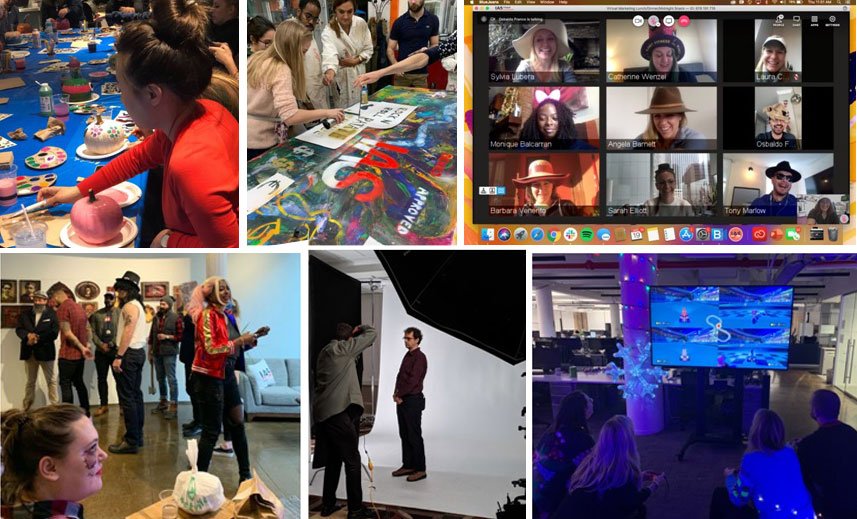
14. We have heard that you have a very fun work culture, so can you share with us some of the fun pictures of your workplace?
15. Can you give us a glance of the applications you use on your phone?
Camera, Slack, Feedly and Pocket are my most used apps.